


Society
23 March 2026
Explore and connect this spring
Published: 18 Feb 2026
We often think of home as bricks and mortar, but in reality, home is a feeling. It’s the comfort of being yourself, the warmth of familiar faces, and the reassurance of knowing you belong. And that feeling doesn’t have to be limited to your front door. Anthropologist Dr Anna Machin explains…
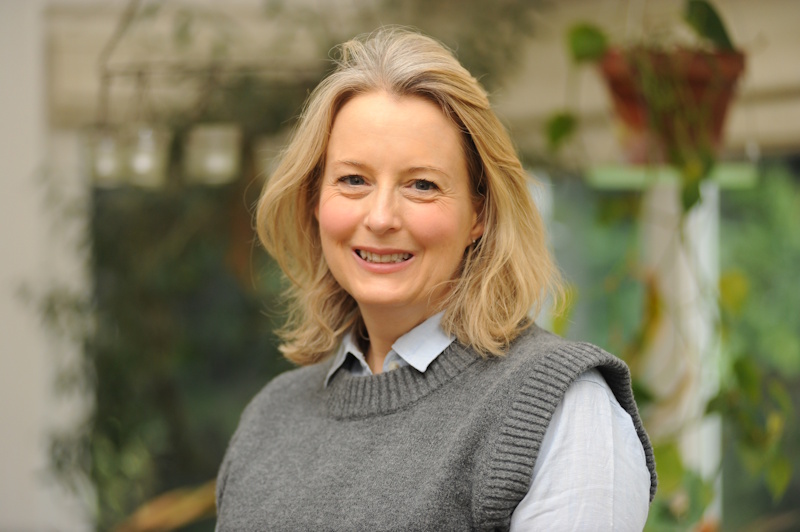
Anthropologist and expert in close human relationships, Dr Anna Machin
There are many practical reasons for needing a house. It provides us with shelter, security and stability. But our need for a home – a place of belonging, comfort, and connection – is just as important.
If you look back to the dawn of man, our basic survival needs of food, water and shelter have never existed in isolation. Our ancestors also relied on the community around them for protection, trust and support.
Dr Machin says that while we no longer depend on others for day-to-day survival, this deep psychological need for a ‘home’ has not gone away.
She said: “We know socialising and being among friends or a community brings us happiness, but being among a group where you feel at home fulfils a much deeper psychological need to belong.
“From an evolutionary perspective, friends increase our chance of survival. And while we no longer need people to help us protect us from predators or help us hunt for food, we are still much happier and more comfortable when we have a community where we belong – whether that’s a family, a friendship group, or a social group like the Oddfellows.”
Humans have been pondering what makes us not only survive but thrive for thousands of years.
American psychologist Abraham Maslow created a much-recognised pyramid of human needs – five levels that express what motivates human behaviour. Physiological requirements such as food, water and shelter sit at the base, followed by safety and security, and then love and belonging.
This suggests that relationships are secondary to survival. However, Dr Machin argues that social connection should be considered a fundamental priority – particularly later in life.
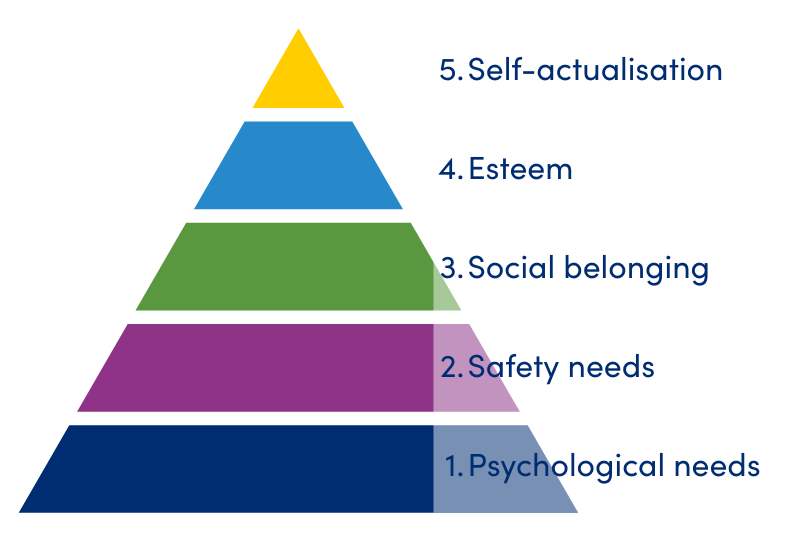
Maslow’s Hierarchy of Needs
“With security on the second level of Maslow’s hierarchy and relationships on the third, it implies they aren’t essential for survival,” explains Dr Machin. “But for older people in particular, social isolation is a chronic condition with serious mental and physical consequences.”
A sense of home can provide a level of security that goes far beyond having your basic needs met. Just as a physical home protects us from external danger, a supportive community offers protection against social isolation and loneliness.
Dr Machin explains: “When it comes to feeling secure, an organised friendship group gives you a huge advantage. A supportive group provides a buffer against social isolation and uncertainty.”
She added that the reliability of groups such as the Oddfellows offers reassurance through routine and familiarity, giving people a ready-made ‘home’ where they can belong.
“Humans are naturally suited to group living, and it is within these shared spaces that we feel most relaxed and secure,” Dr Machin added.
According to the National Institute of Health, social isolation increases the risk of developing dementia by 50%, and heart attacks and strokes by 30%. Even more concerning, the World Health Organization reports that loneliness is linked to an estimated 100 deaths every hour across the globe – more than 871,000 deaths each year.
“These figures highlight that belonging is not simply about enjoyment or companionship, it is a vital component of long-term health and wellbeing,” added Dr Machin.
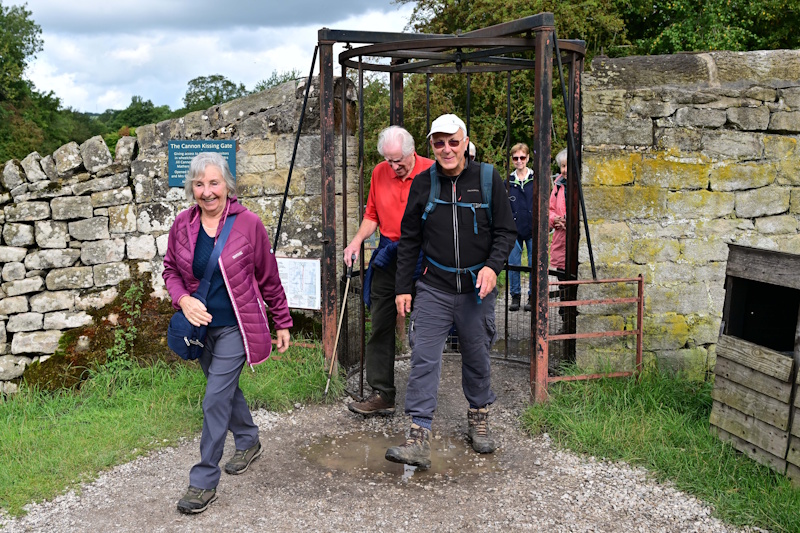
Members of Derbyshire Peak Oddfellows regularly head out on short walks together in the area
Beyond security and fulfilling our needs to socialise, finding a group where you truly belong can also improve your health.
Dr Machin explains: “Bio-behavioural synchronicity occurs when we share a strong bond with people we spend a lot of time with. You may begin to speak in similar ways, adopt the same gestures or tone of voice, and even experience alignment in biological processes such as heart rate, hormones and brain activity.
“While often studied in the context of close relationships like that between a mother and child, bio-behavioural synchronicity can also develop within groups of like-minded people.
“It’s the result of an ultimate bond – feeling completely comfortable and understood,” she says. “Groups such as the Oddfellows offer a natural foundation for this connection.
“Members often share similar life stages, experiences and outlooks, creating an environment where synchronicity can develop more easily. And where we share similar experiences there is a shortcut to trust. We are able to view the world from the same perspective and that leads to a sure and fast bond.”
Importantly, the effects of bio-behavioural synchronicity go beyond emotional closeness. As Dr Machin discusses in her book, Why We Love: The Definitive Guide to our most Fundamental Need, research shows that being around trusted peers releases beta endorphins that support the immune system and promote good health.
In cases of bio-behavioural synchronicity, even physiological measures such as heart rate and blood pressure can begin to align – potentially reducing stress-related health risks.
Social connection has been shown to have a greater influence on health than diet or exercise, making it especially important for those who may no longer be able to engage in physical activity. Spending time with peers and maintaining meaningful social bonds offers a powerful and accessible way to support long-term health.
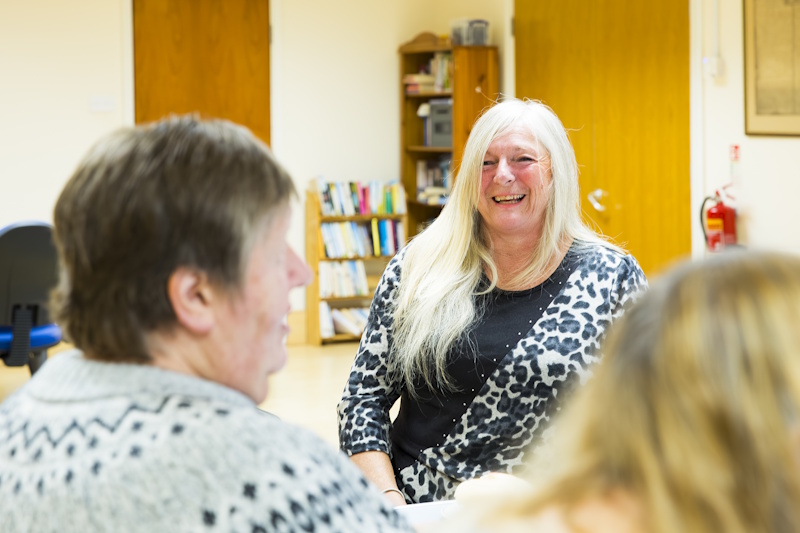
Leeds Oddfellows members get together regularly to enjoy a mix of events at its hall.
While the Oddfellows can’t put a roof over your head, its groups can provide you with an environment where you can feel completely at home.
It brings structure, reliability and shared understanding, helping people feel at home quickly while offering meaningful health benefits.
Dr Machin added: “Structure and reliability are both important for feeling supported and comfortable.
“And that’s where the Oddfellows is extremely reliable. Not only are you provided with a group of friendly people with a common purpose, but it also provides comfort in its predictability.
“Once you’ve attended one or two Oddfellows meetups, people understand how it works. They know when the next event is, when it starts and ends, and what’s expected of them.
“That predictability creates a sense of comfort and makes it easy for people to feel at home very quickly.”
She added: “If we go back to Maslow’s pyramid, it’s worth noting that it also works on a basis that you have to achieve the base levels before moving on to needs such as self-esteem and personal growth.
“So, while the Oddfellows can give you a place to belong, it can also give you the foundations for other areas of life too.”
Oddfellows friendship groups are welcoming spaces for people to connect, support one another, and enjoy life together. Over 750 hosted social events and activities are held across the UK each month. Give one a try. There’s no obligation to join.
You can find your nearest Oddfellows Branch by using our Branch Finder, or use our Events Finder to search for social events and activities happening near to where you live or online.
Contact us to request your free information pack and local events diary.
Register for an online open day.
Read more advice on making friends in later life and building social confidence in our friendship guides section.
Anna is a doctor of evolutionary anthropology, a writer and broadcaster. She is world renowned for her work in the science and anthropology of close human relationships.
She is also the author of Why We Love: The Definitive Guide to our most Fundamental Need. www.annamachin.com